

Search behaviour is changing. People aren’t just typing queries into Google anymore – they’re describing problems to ChatGPT and expecting direct answers and recommendations. That shift has opened a brand-new advertising surface, and as of August 2026, it’s live for Indian businesses.
And here’s the catch: this window won’t stay open for long. Every new ad platform has an early phase with cheaper clicks, less competition, and an audience that hasn’t been “sold to” yet – Google Ads and Meta Ads both had this phase, and early movers built an advantage that latecomers took years to catch up on.
Self-serve access to Ads Manager is now live in India, giving businesses a new channel alongside Google Ads, Meta Ads, and organic search. The question isn’t whether ChatGPT Ads will go mainstream – it’s whether your business gets there first.
What Are ChatGPT Ads?
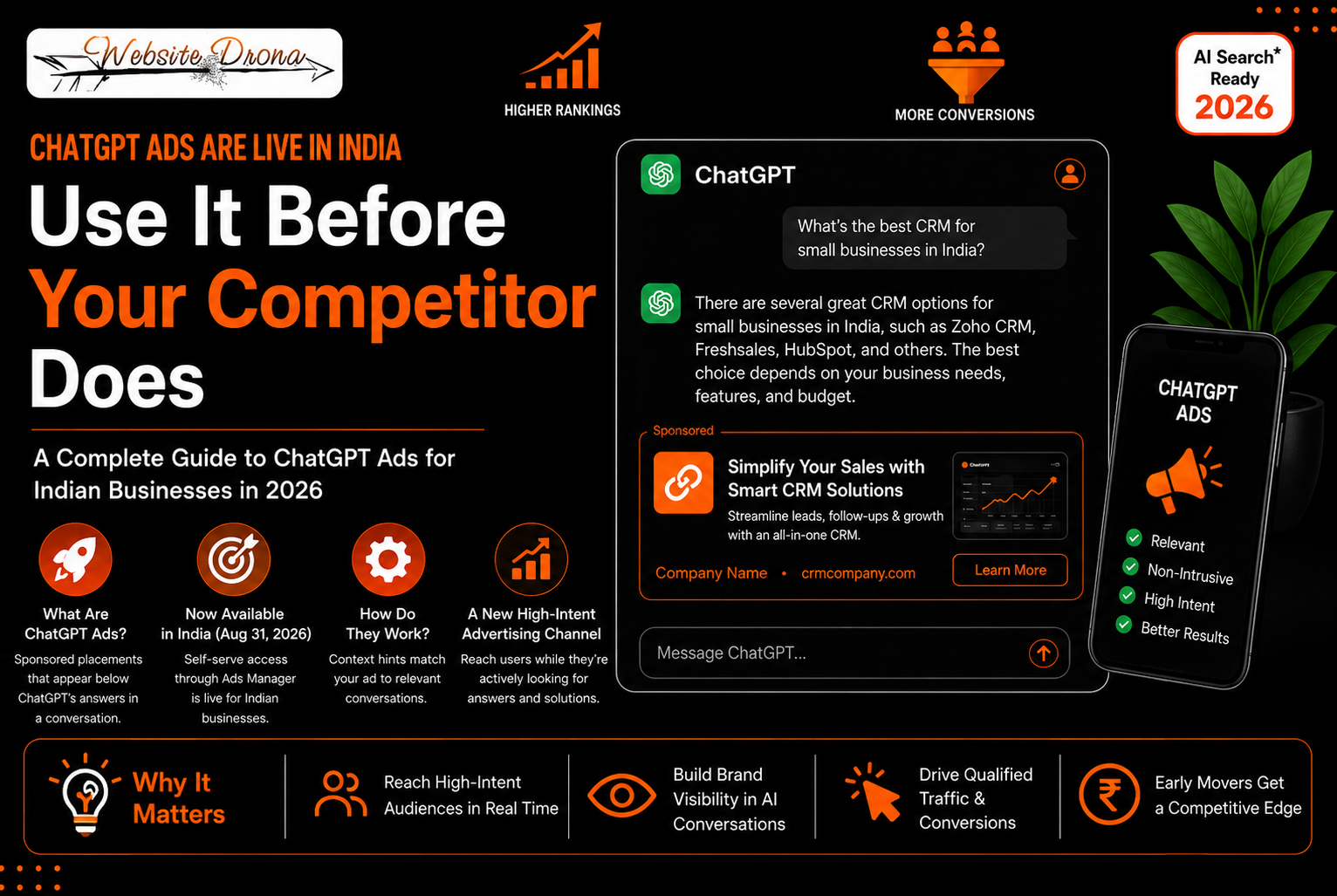
ChatGPT Ads are sponsored placements that appear below ChatGPT’s answers inside a conversation. They are visually distinct and clearly labeled as advertising, and they sit underneath the model’s response rather than inside it.
A typical ad unit can include:
- Advertiser name
- Favicon or logo
- Ad title
- Ad copy/description
- An image creative
- A link to the advertiser’s landing page
The important distinction is that the ChatGPT answer itself is never influenced by advertising. ChatGPT generates its response first, based on what’s most helpful to the user, and a relevant ad may then be matched underneath based on the conversation topic. OpenAI has been explicit on this point: sponsored content is separated from – and does not shape – the model’s actual output.
Are ChatGPT Ads Available in India in 2026?
Yes. This is the freshness hook that makes this a live opportunity rather than a “someday” channel.
OpenAI began showing ads to logged-in adult users on ChatGPT’s Free and Go plans in India, and on August 31, 2026, it opened direct, self-service purchasing through Ads Manager for Indian businesses – meaning any advertiser can now set up and run a campaign without going through OpenAI’s sales team or an agency.
A few details worth knowing:
- Who can advertise: Eligible businesses in India can create campaigns directly through Ads Manager, subject to account, billing, and advertising policy requirements.
- Agency partners: OpenAI named WPP and Omnicom as its first agency partners for the Indian market, for advertisers who’d rather manage campaigns through an agency relationship.
- Who sees the ads: Only users aged 18 and above on ChatGPT’s Free and Go plans in India. Plus, Pro, Business, and Enterprise users never see ads.
- Why India matters: India is one of ChatGPT’s largest and most active markets by user count, which is a big part of why OpenAI prioritised it in this expansion, alongside Europe, the Middle East, and North Africa.
For Indian marketers, this means the “wait and see” period is over – the platform is open. Early movers get to build experience and campaign data before the auction gets crowded.
How Do ChatGPT Ads Work?
The system follows a logical flow, even though a couple of the steps work differently from platforms you may already know:
Campaign → Ad Group → Context Hints → Ad Creative → ChatGPT Conversation → Ad Impression/Click → Landing Page → Conversion
Breaking that down:
- Campaign: Sets your objective, overall budget, start/end dates, and geographic targeting.
- Ad Group: A themed collection of ads built around one intent area or audience. This is also where you write your context hints.
- Context Hints: Plain-language descriptions of the conversations, topics, or needs where your ad might be relevant.
- Ad: Contains your title, copy, image, and landing page link.
- ChatGPT Conversation: The live conversation a real user is having with the model.
- Ad Impression/Click: If your ad is judged relevant to that conversation, it may be shown; a click sends the user to your landing page.
- Landing Page: Where the actual conversion happens.
- Conversion Measurement: Tracked through UTMs, a pixel, and a Conversions API, so you can tie ad spend back to real outcomes.
Ads Manager’s current beta structure follows exactly this three-tier hierarchy – Campaign, Ad Group, Ad – and supports both a guided, step-by-step campaign builder and a bulk-upload workflow for advertisers managing many campaigns at once.
How Is ChatGPT Advertising Different From Google Ads?
This is one of the most useful comparisons to understand before you plan a budget, because the instincts that work in Google Ads can actively mislead you here.
| Google Ads | ChatGPT Ads |
| Search queries | Conversational context |
| Keywords play a major role | Context + intent signals |
| Search results page | Inside a ChatGPT conversation |
| Query-based intent | Problem/goal-based intent |
| Keyword targeting, match types | Context hints + limited targeting options |
| A discrete search journey | An extended, conversational decision journey |
It’s worth being precise here: ChatGPT Ads are not a replacement for Google Ads. Google Ads captures a moment of explicit search intent – someone typed a specific query. ChatGPT Ads create opportunities around a broader, conversational kind of intent – someone describing a goal, a problem, or a decision they’re working through, sometimes across several back-and-forth messages.
OpenAI’s own documentation confirms this structural difference: ad selection is based on multiple relevance signals – conversation context and intent, landing page content, ad title and copy, and the context hints and targeting an advertiser has set – rather than a single query-to-keyword match.
How Does ChatGPT Ad Targeting Work?
Conversational Intent
The same underlying need shows up very differently depending on how someone phrases it. Compare:
“I need a website for my logistics company that can handle order tracking and client logins.”
versus a Google-style query:
“website design company”
The first is a fuller, business-specific need. Advertisers who think in terms of these fuller conversational statements – not short keyword fragments – tend to write better context hints.
Context Hints
Context hints are the primary targeting control in ChatGPT Ads, and they are genuinely different from keywords:
- They are written as plain-language descriptions of conversations, topics, or user needs – not lists of keyword fragments.
- Each ad group carries roughly one focused hint (OpenAI’s documentation caps this at a limited character count).
- They guide ad matching; they do not guarantee it. OpenAI is explicit that context hints are not exact-match targeting rules.
- Good hints describe a broad thematic area – the situations, needs, or questions a real person might bring to ChatGPT – rather than narrow keyword strings.
- Best practice is to keep each ad group focused on a single product, theme, or intent area, and to create separate ad groups for meaningfully different audiences rather than combining them.
Because context hints live at the ad group level, scaling a campaign properly usually means building more ad groups – one per audience/intent combination – rather than trying to stretch one broad hint to cover everything.
Landing Page Relevance
The system also reads your landing page content as a relevance signal. A landing page that clearly matches your ad’s claim and your context hint’s intent supports better matching and a better auction outcome – not just a better user experience after the click.
Ad Copy Relevance
Your ad title and description are read the same way – as inputs into how relevant the system judges your ad to be for a given conversation, not just as creative for a human to read.
Location & Audience Targeting
Current targeting supports country-level geography, while more granular location options may be available in selected markets. Location availability can vary by country. Audience targeting beyond geography and context hints is still limited compared to mature platforms like Google Ads or Meta Ads – this is a young advertising system, and OpenAI has said it plans to add more targeting options, formats, and buying tools over time.
What Is ChatGPT Ads Manager?
Ads Manager is OpenAI’s self-serve platform for creating, running, and measuring ChatGPT ad campaigns – the direct equivalent of Google Ads or Meta Ads Manager for this channel.
Inside it, advertisers can:
- Set up an account and complete billing details
- Create campaigns through a guided workflow or via bulk upload
- Build ad groups with context hints and bid settings
- Create ads with titles, copy, images, and landing pages
- Set a budget, campaign dates, and geographic targeting
- Track performance through table views, charts, and CSV exports
- Manage account settings, including team members, permissions, API access, and billing history
Campaigns go through a review step and won’t start delivering until all required setup fields are complete, so it’s worth building in a small buffer between finishing a campaign and expecting it to go live.
How to Advertise on ChatGPT in India – Step-by-Step (Ads Manager Walkthroug)
1. Set up your Ads Manager account
Go to ads.openai.com and create your advertiser account, then complete your business details.
2. Create a campaign
Click “+ Create” to start a new campaign and give it a clear, descriptive name (e.g., “[Your Company Name] campaign”).
3. Select your objective
Choose your goal from the dropdown – Clicks, Reach, or Conversions, depending on what’s available and what you want to achieve.
4. Set location targeting
Add your desired country/region under “Locations for this campaign” (e.g., India). You can also exclude specific areas using “Locations to exclude from this campaign” if needed.
5. Choose eligible platforms
“All platforms” is the default – you can restrict this to a specific platform if you want more control.
6. Landing page query parameters
If you need tracking, add template values like {campaign_id}, {ad_group_id}, {ad_id} here.
7. Include/exclude custom audiences
Upload your own audience lists to narrow or exclude specific segments from seeing your ads.
8. Set your budget and schedule
- Choose your budget type (e.g., Daily budget)
- Set an amount that fits your overall marketing budget
- Set your Start Date & Time
- Optionally enable and set an End Date
9. Attach a conversion event
Select the conversion event relevant to your goal (e.g., lead generation, sign-up, purchase) so results get tracked properly. Use “+ Add event” to track additional events.
10. Create an ad group
Build each ad group around one specific theme, product line, or service (e.g., one ad group per offering).
11. Choose your bid strategy
- Maximize results – the system automatically adjusts your bid to get the most results from your budget (recommended for beginners)
- Manual: Max CPC – you set your own maximum cost-per-click
12. Write your context hints
This is one of the most important fields – describe your products/services naturally, in your own words, so your ad matches relevant conversations happening on the platform.
13. Create your ad
- Ad Name – for internal reference
- Title – max 50 characters
- Description – max 100 characters
- Link – your landing page URL (ideally a dedicated page, not your generic homepage)
- Image – upload a relevant visual
14. Check the preview
Before saving, review the “Preview” section to see exactly how your ad will appear – business name, “Ad” label, title, and description all render together.
15. Submit for review
OpenAI checks your creative against its guidelines – ads that are misleading, aggressive, or visually jarring may get rejected.
16. Monitor and optimize
Track Impressions, Clicks, Conversions, Spend, CTR, and Avg CPC – all visible under the Campaigns, Ad groups, and Ads tabs. Use this data to keep refining your context hints, bid strategy, and creative.
How Much Do ChatGPT Ads Cost in India?
Pricing details are genuinely still settling as the auction fills up, so treat any specific number as directional rather than fixed.
ChatGPT Ads Pricing Models
Three buying models exist:
- CPM (Reach) – you pay per thousand impressions, best suited to brand awareness goals.
- CPC (Clicks) – you pay per click, best suited to driving traffic.
- oCPC (conversion-optimised) – billed per click, but the system optimises delivery toward a tracked conversion event you define, once conversion tracking is properly configured.
Actual advertising costs can vary based on factors such as campaign objective, competition, relevance, and available delivery opportunities. Ad relevance is an important part of the system, so better-matched advertising can have an advantage over less relevant ads.
Minimum Daily Budget in India
OpenAI’s documentation lists a minimum daily budget of ₹725 for campaigns running in India.
It’s worth being careful with how this number gets used: ₹725 is a platform minimum, not a promise of results. How much traffic, engagement, or leads that budget generates depends entirely on your industry, your competition in the auction, your creative quality, and your context hints – not on the budget figure alone.
What Types of Businesses Should Advertise on ChatGPT?
Some categories are a more natural fit for conversational advertising than others, largely because their customers already research and compare options through extended, back-and-forth questions.
E-commerce Businesses
Someone asking ChatGPT to compare products or find “the best X under ₹Y” is already in a buying mindset.
SaaS & Technology Companies
Buyers often describe a workflow problem before naming a category of tool – a good fit for context-hint-based matching.
Digital Marketing Companies
Prospects frequently ask ChatGPT open-ended questions about growing their business online before they know which service they need.
Website Design & Development Companies
“I need a website for my logistics company” is a conversational-intent example that maps directly to this category.
B2B Businesses
Long consideration cycles and problem-first questions suit a channel built around described needs rather than short keywords.
Education & Training
Course and program research is naturally conversational – “what should I study to switch into data analytics” is a common pattern.
Real Estate
Buyers describe budgets, locations, and requirements in detail – good material for context hints.
Professional Services
Legal, accounting, and consulting queries are often framed as a described situation rather than a search term.
Local Businesses
This is the category to be most realistic about. Since ads only reach the Free and Go tier audience, and local intent queries on ChatGPT are still a smaller share of usage than on Google or Maps, results here may be more variable early on.
Benefits of ChatGPT Ads for Indian Businesses
- Reach users during decision-making – while they’re actively working through a choice, not just browsing.
- Conversational intent – richer context than a short keyword search often provides.
- Context-aware advertising – matching based on the actual topic and need, not just a query string.
- A new paid acquisition channel – additional inventory outside the usual Google/Meta duopoly.
- Complementary to search advertising – a different moment in the customer journey, not a swap for existing search spend.
- A fit for high-consideration services – where a fuller conversational description carries more signal than a two-word search.
- Conversion measurement – UTMs, pixel, and Conversions API support tying spend to outcomes.
- Potential for more relevant ad experiences – because matching draws on richer context than keyword-only systems.
It’s worth being honest about the limits here too: ChatGPT Ads don’t automatically produce “higher conversion rates” simply by existing on a new platform. The phrase that holds up is that they can create opportunities for more relevant advertising – actual performance still depends on your offer, creative, landing page, and targeting, exactly as it does everywhere else.
ChatGPT Ads vs SEO vs AEO vs GEO
These four terms get used loosely, so it helps to separate them clearly:
- SEO (Search Engine Optimization) – Improving visibility in traditional organic search results.
- AEO (Answer Engine Optimization) – Structuring content so AI systems can pull it into direct answers to user questions.
- GEO (Generative Engine Optimization) – Improving how your brand appears within generative AI and AI-powered search experiences more broadly.
- ChatGPT Ads – Paid visibility specifically within ChatGPT’s advertising environment, independent of your organic AI visibility.
A simple framework:
- SEO → Organic Search Visibility
- AEO → Answer Visibility
- GEO → Generative Search Visibility
- ChatGPT Ads → Paid AI Visibility
These four are complementary, not competing. Strong AEO and GEO work can make your brand more likely to be mentioned organically inside ChatGPT’s answers; ChatGPT Ads provide paid opportunities to appear within ChatGPT’s advertising environment, subject to eligibility, relevance matching, and delivery conditions, regardless of whether the model would have referenced you organically.
How to Prepare Your Website for ChatGPT Ads
Before you spend anything, a few fundamentals make a real difference to both your ad performance and your matching quality:
Create Dedicated Landing Pages
Send ad traffic to a page built for that specific offer – not your homepage – since landing page content is itself a relevance signal.
Make Your Value Proposition Clear
State what you do and who it’s for in the first few lines, in plain language.
Improve Website Speed
Slow pages lose clicks before they convert, regardless of how well the ad was matched.
Mobile Optimization
Your landing experience needs to provide a strong experience across mobile and desktop devices.
Add Trust Signals
Reviews, client logos, certifications, or case studies matter more when a visitor is arriving mid-decision rather than mid-browse.
Create Strong CTAs
Be specific about the next step – “Request a Free Consultation” outperforms a generic “Contact Us.”
Improve Conversion Experience
Reduce friction – fewer form fields, clear next steps, fast load times.
Set Up Analytics & Conversion Tracking
Configure your tracking pixel and Conversions API integration before launch, not after. Without it, you’re flying blind on which context hints and creative are actually working.
How to Create Effective ChatGPT Ads
OpenAI’s own guidance for advertisers points to a few consistent principles:
Write Clear Headlines
Say what you offer directly – this isn’t the place for clever, ambiguous copy.
Focus on Benefits
Lead with the outcome for the user, not just a feature list.
Match the User’s Need
Your ad copy should feel like a natural continuation of the kind of conversation your context hints describe.
Use Different Ad Variations
Run multiple distinct creatives per ad group rather than repeating the same message – this is how you find what resonates.
Keep Each Ad Group Focused
One theme, one intent area, one audience per ad group – resist the temptation to combine unrelated offers.
Align Ad With Landing Page
The promise in your ad copy and the content on your landing page need to match closely, both for user trust and for the system’s relevance scoring.
ChatGPT Ads Strategy for a Business in India: A Worked Example
Business: A website design company. Goal: Generate qualified leads for website development projects
Campaign: Website Development Leads
Ad Group 1: Ecommerce Website Development
Context Hints:
- Businesses looking for ecommerce website development
- Companies planning to launch an online store
- Brands needing a conversion-focused ecommerce website redesign
Ad: “Ecommerce Website Development – Built to Convert”
Landing Page: A dedicated Ecommerce Website Development service page (not the homepage)
CTA: “Request a Free Consultation”
This structure – one focused ad group per real buyer scenario, context hints written the way an actual customer would describe their need, and a landing page built specifically for that offer – is the pattern most likely to perform well as the channel matures in India.
How to Measure ChatGPT Ads Performance
Track the same fundamentals you would on any paid channel, adapted to this platform’s reporting:
- Impressions
- Clicks
- CTR (click-through rate)
- CPC (cost per click)
- CPM (cost per thousand impressions)
- Spend
- Conversions (where tracking is configured)
- Conversion rate
- Cost per conversion
- Qualified leads
- Revenue (where attribution is connected through to sales)
OpenAI’s current Ads Manager reporting covers impressions, clicks, spend, CTR, average CPC, average CPM, and conversions, provided conversion measurement has been set up correctly. Note that attribution can lag – some sources report a 24–48 hour delay before conversion data is fully reflected, so same-day dashboards may understate real performance.
Common ChatGPT Advertising Mistakes to Avoid
Mistake 1: Treating context hints like keywords. Short keyword fragments underperform full, natural descriptions of a real need or situation.
Mistake 2: Using one generic ad per ad group. Without creative variation, you can’t tell what’s actually resonating.
Mistake 3: Sending every user to the homepage. Generic landing pages hurt both conversion rate and relevance matching.
Mistake 4: A weak or slow landing page. No amount of ad relevance survives a landing page that doesn’t load or doesn’t convert.
Mistake 5: No conversion tracking. Without a pixel and Conversions API set up before launch, you’re optimising blind.
Mistake 6: Focusing only on clicks. Clicks without conversion context tell you traffic volume, not business impact.
Mistake 7: Making unsupported AI/ROI claims. Avoid promising specific results from a platform minimum budget or general “AI targeting” claims that current documentation doesn’t support.
Mistake 8: Ignoring creative testing. Treat your first campaign as a test, not a final version – early results should shape your second and third iterations.
Should Your Business Advertise on ChatGPT in 2026?
ChatGPT Ads may make sense if:
- Your audience actively researches solutions before buying
- Your product or service has clear, describable commercial intent
- You already have (or can build) strong, offer-specific landing pages
- You can properly track conversions
- You’re willing to treat this as a genuine test, not a guaranteed win
Don’t treat it as a replacement for:
- SEO
- Google Ads
- Meta Ads
- Content marketing
- GEO/AEO efforts
The most sensible approach is to integrate ChatGPT Ads into a broader digital marketing strategy – a new, complementary channel to test with a modest budget, not a channel to bet your entire acquisition plan on this early in its life.
Conclusion
ChatGPT Ads in India are no longer a future possibility – as of August 31, 2026, they’re a live, self-serve channel that any Indian business can set up directly through Ads Manager. The mechanics are still young: context hints replace keywords, targeting options are limited compared to mature platforms, and pricing is still settling as more advertisers join the auction. But the fundamentals are already clear enough to act on – conversational intent is a real signal, relevance is rewarded over aggressive bidding, and the audience (India’s enormous ChatGPT free-tier base) is genuinely large.
For most Indian businesses, the right move isn’t to shift budget away from Google Ads, Meta Ads, or SEO – it’s to treat ChatGPT Ads as a small, deliberate test alongside them. Start with one focused ad group, one well-built landing page, and proper conversion tracking from day one. Let a modest budget teach you how your category performs in this auction before scaling anything up. Businesses that test the channel early can begin building campaign experience and benchmarks before the advertising ecosystem matures further.
Ready to Explore AI-Powered Advertising?
As AI search changes how customers discover and evaluate businesses, your advertising strategy needs to evolve. Website Drona can help you build the website, landing pages, PPC campaigns, and AI-search strategy you need to compete across traditional and emerging search channels.
Talk to Our Digital Marketing Experts
Frequently Asked Questions About ChatGPT Ads in India
What are ChatGPT Ads?
Sponsored placements that appear below ChatGPT’s answers, clearly labeled as advertising and separate from the model’s actual response.
Are ChatGPT Ads available in India?
Yes. OpenAI opened direct, self-service access to Ads Manager for Indian businesses on August 31, 2026.
How can I advertise on ChatGPT?
Set up an account on OpenAI’s Ads Manager, complete billing details, and build a campaign directly – or work through one of OpenAI’s named agency partners, WPP or Omnicom, in the Indian market.
How much do ChatGPT Ads cost in India?
There’s no fixed answer – pricing runs through an auction. The platform’s minimum daily budget in India is ₹725, but actual cost per click or impression depends on competition and relevance in your category.
What is ChatGPT Ads Manager?
OpenAI’s self-serve platform for creating, running, and measuring ChatGPT ad campaigns, structured around campaigns, ad groups, and ads.