

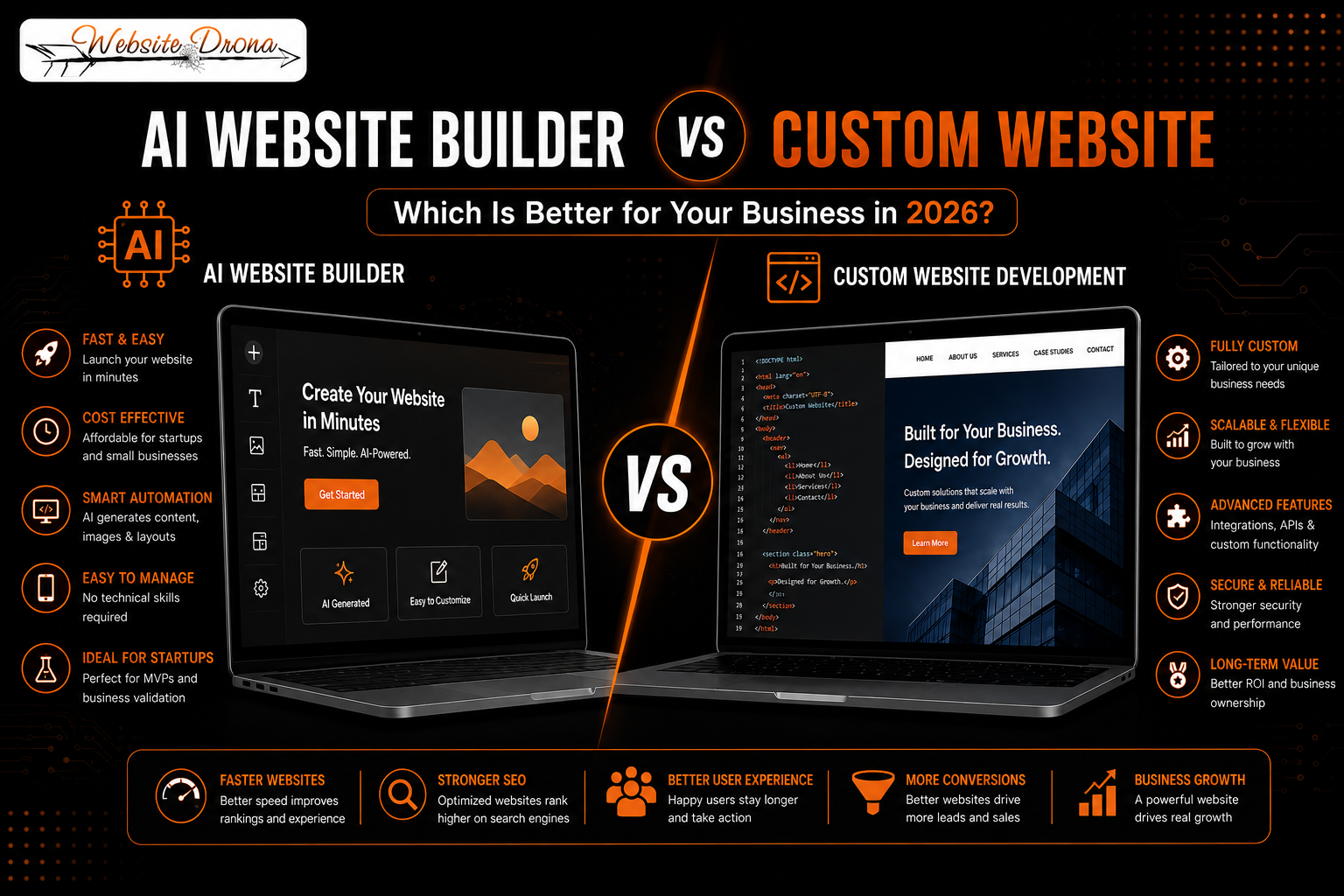
AI Website Builder vs Custom Website: Which Is Be…AI is changing how businesses approach website development. Modern AI website builders can generate website layouts, content, and basic functionality in significantly less time, making website creation more accessible to startups, small businesses, and entrepreneurs.
But launching a website quickly does not necessarily mean building the right website for long-term business growth.
At Website Drona, we work with businesses that need websites designed around their goals, user experience, functionality, and long-term growth. This experience shows why choosing a website development approach should go beyond simply comparing development speed or initial cost.
As a business grows, its website may need custom functionality, third-party integrations, stronger SEO capabilities, better performance, advanced security, and greater scalability. These requirements choose between an AI website builder and custom website development increasingly important.
Businesses today generally have three approaches to consider: an AI website builder, custom website development, or AI-assisted custom development, where professional developers use AI tools to accelerate selected parts of the development process.
What Is an AI Website Builder?
An AI website builder is a platform that uses artificial intelligence to help create a website based on a user’s instructions, business information, or selected requirements.
Instead of starting from scratch, users can describe their business, target audience, preferred style, and website goals. The platform can then generate elements such as page layouts, website copy, images, sections, and other components.
Most AI website builders combine AI generation with templates, pre-built components, visual editors, hosting, and content management features.
How Does an AI Website Builder Work?
The typical process includes:
- Define Your Requirements — Provide information about your business, industry, audience, and website goals.
- Generate the Website — AI creates an initial structure, design, and content.
- Customize the Result — Modify text, images, sections, branding, and available features.
- Add Functionality — Enable forms, analytics, e-commerce, booking features, or supported integrations.
- Publish the Website — Launch the website through the platform’s hosting environment.
This approach can significantly reduce the time required to create a basic website.
Benefits of AI Website Builders
AI website builders can be useful when a business:
- Needs a website quickly
- Has relatively simple requirements
- Has limited technical resources
- Wants to test a business idea
- Needs a basic online presence
- Wants an easy-to-manage website
- Is creating an initial prototype or MVP
Limitations of AI Website Builders
The main consideration is how much control the platform provides as requirements become more complex.
Potential limitations include:
- Platform dependency
- Restrictions on advanced customization
- Limited control over complex functionality
- Platform-specific integrations
- Less control over underlying infrastructure
- Migration considerations
- Limitations for highly specialized workflows
These limitations do not make AI website builders unsuitable. They simply mean businesses should evaluate whether the platform can support both their current and future requirements.
What Is Custom Website Development?
Custom website development involves designing and developing a website around specific business requirements instead of relying primarily on a fixed website-building platform.
A custom website can include tailored UI/UX, custom functionality, databases, APIs, integrations, authentication systems, business workflows, and other technical components required by the organization.
The development process can involve designers, developers, project managers, SEO specialists, and other professionals depending on the project’s complexity.
How Does Custom Website Development Work?
A professional custom website development process generally includes:
- Requirement Analysis — Understanding business objectives, users, features, and technical requirements.
- Planning & Architecture — Defining the sitemap, information architecture, technology, functionality, and technical structure.
- UI/UX Design — Creating the user experience and visual interface around the brand and target audience.
- Frontend Development — Building the parts of the website users interact with.
- Backend Development — Developing databases, business logic, authentication, APIs, and server-side functionality where required.
- Integration — Connecting CRM, ERP, payment gateways, analytics, APIs, or other third-party systems.
- Testing — Testing functionality, responsiveness, compatibility, performance, and security.
- Deployment — Launching the website in its production environment.
- Maintenance & Optimization — Monitoring and improving the website as business requirements evolve.
What Makes a Website Truly Custom?
Changing the colors, fonts, or content of a template does not necessarily make a website custom.
There is a significant difference between:
- Template customization
- CMS-based customization
- Custom UI/UX
- Custom functionality
- Custom integrations
- Custom backend systems
- Fully tailored web applications
The more closely a website is built around unique business requirements, the greater the value of professional custom development.
Benefits of Custom Website Development
Custom development can provide:
- Greater design flexibility
- Custom functionality
- More control over website architecture
- Advanced integrations
- Greater scalability
- Tailored user experiences
- Greater control over technical implementation
- Flexibility for future requirements
The trade-off is that custom development generally requires more planning, technical expertise, development time, and ongoing maintenance.
AI Website Builder or Custom Development: What Sets Them Apart?
The most important difference is not simply development speed. It is the level of control and flexibility available as your business requirements evolve.
| Factor | AI Website Builder | Custom Website |
| Development Speed | Very fast | Generally longer |
| Initial Setup | Simple | Requirement-based |
| Customization | Platform-dependent | Extensive |
| Design Control | Platform-dependent | High |
| Custom Functionality | Limited by platform capabilities | Highly flexible |
| Integrations | Supported integrations | Custom integrations possible |
| Scalability | Platform-dependent | Highly flexible |
| Code Control | Limited or platform-dependent | Greater control |
| Infrastructure Control | Platform-dependent | Greater control |
| SEO Implementation | Platform-dependent | Greater technical control |
| Maintenance | Often simpler | Requires technical management |
| Business-Specific Workflows | Platform-dependent | Highly flexible |
| Long-Term Flexibility | Platform-dependent | High |
The right choice depends on what your business actually needs from its website. The right choice depends on your business model, website complexity, budget, growth plans, and technical requirements.
Quick Answer: Which Approach Is Right for You?
| Business Requirement | Recommended Approach |
| Simple business website | AI Website Builder |
| Fast MVP | AI Website Builder / AI-Assisted Development |
| Standard service website | AI Website Builder or CMS |
| Growing business | Custom or Hybrid Approach |
| Complex e-commerce | Custom or Advanced Platform |
| SaaS / Web Application | Custom Development |
| Complex integrations | Custom Development |
This is a starting point rather than a universal rule. Your actual requirements should determine the final technology choice.
SEO Considerations for AI and Custom Websites
SEO should be considered before choosing a website development approach, particularly if organic search is expected to generate consistent traffic and leads.
AI website builders may provide features such as:
- Page titles and meta descriptions
- XML sitemaps
- Mobile-friendly layouts
- Image optimization
- Basic structured data
- Analytics integrations
However, the level of technical SEO control varies between platforms.
Custom website development can provide greater control over:
- URL structures
- Canonical implementation
- Internal linking
- Structured data
- Rendering
- Page templates
- Indexation controls
- Technical architecture
- Performance optimization
Which Is Better for SEO?
Neither option is automatically SEO-friendly.
An AI-built website can perform well in search if it is properly structured, optimized, and supported by useful content. Similarly, a poorly developed custom website can have technical SEO issues.
The important factors include:
Technical implementation + content quality + website architecture + performance + mobile experience + ongoing SEO
For businesses with complex website structures or advanced technical SEO requirements, custom development can provide greater control over implementation.
Performance Considerations
Website performance directly affects user experience and can influence how effectively visitors engage with a website.
Important performance factors include:
- Page loading speed
- JavaScript execution
- Image optimization
- CSS efficiency
- Server response time
- Caching
- Third-party scripts
- Core Web Vitals
AI website builders can simplify performance management because hosting and much of the infrastructure are handled by the platform.
However, this can also mean less control over the underlying technical environment.
Custom development can provide greater control over:
- Code
- Scripts
- Assets
- Hosting
- Server configuration
- Caching
- Database queries
- Performance optimization
This can be valuable for websites with demanding performance requirements.
However, custom development does not automatically guarantee better performance. Poor implementation, unnecessary scripts, unoptimized media, or inadequate hosting can affect any website.
Security Considerations
Security is another important consideration when choosing how a website should be developed.
AI website builders generally manage parts of the platform infrastructure, hosting environment, updates, and security systems. This can reduce the technical maintenance required from the business.
Custom websites require greater attention to areas such as:
- Software updates
- Authentication
- Access control
- API security
- Database security
- Dependencies
- Server configuration
- Backups
- Monitoring
For businesses with specialized security requirements, custom development can provide greater control over the technical environment.
However, security is ultimately dependent on implementation, configuration, integrations, maintenance, and monitoring.
Therefore, businesses should not assume that one development approach is automatically more secure than another.
Cost Considerations
Cost is one of the biggest reasons businesses compare website builders with custom development.
However, comparing only the initial price can lead to the wrong decision.
Costs Associated With AI Website Builders
Depending on the platform, costs may include:
- Subscription fees
- Premium features
- Plugins or applications
- Hosting
- Additional integrations
- Professional customization
- Migration
Costs Associated With Custom Website Development
Custom development costs can include:
- UI/UX design
- Frontend development
- Backend development
- Custom functionality
- API integrations
- Testing
- Hosting
- Security
- Maintenance
- Future improvements
Consider the Total Cost of Ownership
Instead of asking:
Which option is cheaper to launch?
Businesses should also ask:
Which option provides the right value over the long term?
A low-cost solution can become expensive if the business later requires extensive customization, migration, or redevelopment.
Similarly, investing in custom development may not be justified for a simple website with limited functionality.
The right decision depends on the website’s business value, complexity, expected growth, and long-term requirements.
Website Ownership and Portability: What Should Businesses Consider?
Website ownership is often overlooked when businesses choose a website development approach.
Before committing to a platform, businesses should understand what they actually control and what remains dependent on the provider.
Important considerations include:
- Domain ownership — Ensure the business controls its domain.
- Website content — Understand how content can be accessed or exported.
- Customer and business data — Know where important data is stored and how it can be retrieved.
- Code access — Determine whether source code is available when relevant.
- Database access — Understand whether databases can be accessed or exported.
- Hosting flexibility — Check whether the website can be moved to another hosting environment.
- Third-party integrations — Consider how integrations would be handled during a migration.
- Platform dependency — Understand what happens if the business eventually wants to change platforms.
This does not mean every business needs complete technical ownership of every component. However, understanding ownership, access, portability, and migration options can prevent problems as the business grows.
AI-Assisted Custom Website Development
One of the biggest changes in web development is that AI is not limited to website-builder platforms.
Professional developers can also use AI throughout the development process.
AI can assist with:
- Code generation
- Prototyping
- Debugging
- Documentation
- Test creation
- Repetitive development tasks
- Code suggestions
However, professional developers remain responsible for:
- Architecture
- Business requirements
- Code review
- Security
- Database design
- Integration strategy
- Testing
- Performance
- Deployment
- Scalability
- Maintenance
What Is AI-Assisted Custom Development?
Instead of treating AI and developers as competing alternatives, businesses can use AI to accelerate development while retaining professional oversight and control.
This approach can be particularly valuable when a business needs custom functionality but also wants a more efficient development workflow.
Can AI Replace Web Developers?
AI can automate and accelerate many parts of website creation, but that does not mean every website can be built and maintained without professional development expertise.
AI can help with:
- Basic website generation
- Design concepts
- Content drafts
- Prototypes
- Code assistance
- Repetitive development tasks
Professional developers remain important for:
- Complex architecture
- Custom business logic
- Advanced integrations
- Security
- Database systems
- Performance optimization
- Scalability
- Debugging
- Quality assurance
- Deployment
- Long-term maintenance
The role of web developers is changing, but their expertise remains important for projects where business requirements, technical complexity, security, and long-term reliability matter.
The future of web development is therefore less about AI versus developers and more about how effectively businesses and development teams can combine AI capabilities with professional expertise.
When Does an AI Website Builder Stop Being Enough?
An AI website builder may become less suitable when a business requires functionality beyond the platform’s capabilities.
Consider a more customized development approach if you need:
- Complex business workflows
- Custom dashboards
- Multiple third-party integrations
- Advanced customer accounts
- Specialized e-commerce functionality
- Custom APIs
- Advanced automation
- Greater infrastructure control
- Significant scalability
- Highly specialized user experiences
Another important signal is when the website becomes a core part of business operations rather than simply an online presence.
If customers use the website to place orders, manage accounts, make payments, access services, or interact with internal systems, the development approach becomes much more important.
Real-World Examples: Which Approach Should You Choose?
Local Service Business
A local business needs service pages, contact forms, location information, basic SEO, and a mobile-friendly website.
AI Website Builder: May be sufficient.
Startup MVP
A startup wants to test an idea before making a larger investment in development.
AI Website Builder or AI-Assisted Development: Can suit the initial stage.
Growing SME
A growing business may need CRM integrations, advanced forms, marketing automation, and a more customized user experience.
Custom or Hybrid Approach: May provide greater flexibility as requirements grow.
E-commerce Business
An e-commerce business may need integrations for product management, payments, inventory, shipping, customer accounts, analytics, and marketing.
Platform-Based or Custom Development: Depends on the complexity of the business model and required integrations.
SaaS or Web Application
A SaaS product may require user authentication, databases, dashboards, APIs, subscriptions, business logic, security, and scalable infrastructure.
Custom Development: Generally the more appropriate approach.
Enterprise Business
An enterprise website may involve multiple systems, advanced integrations, security requirements, complex workflows, and large-scale content.
Custom Architecture and Professional Development: Usually provide the flexibility required for these environments.
Which Website Development Approach Fits Your Business?
Before choosing between an AI website builder and custom website development, follow a structured decision process.
Step 1: Define Your Business Goals
Determine whether your website is primarily for:
- Branding
- Lead generation
- E-commerce
- Customer service
- Online bookings
- A web application
- Business operations
Step 2: Identify Required Features
Create a clear list of the features your website needs now.
Step 3: Evaluate Future Requirements
Consider where your website may need to be in the next two to three years.
Step 4: Identify Required Integrations
Determine whether you need CRM, ERP, payment systems, analytics, inventory systems, APIs, or other integrations.
Step 5: Consider SEO and Performance
Evaluate your requirements for technical SEO, website speed, Core Web Vitals, mobile experience, and content management.
Step 6: Evaluate Security Requirements
Consider authentication, payments, user accounts, sensitive data, integrations, and access controls.
Step 7: Compare Total Cost of Ownership
Look beyond the initial development cost and consider subscriptions, maintenance, integrations, upgrades, migration, and future development.
Step 8: Select the Right Approach
Based on these requirements, choose between:
AI Website Builder
Custom Website Development
or
AI-Assisted Custom Development
AI Website Builder vs Custom Website: Which Is Better for Your Business?
There is no universal winner. The right option depends on your business requirements.
Choose an AI Website Builder If:
- Your requirements are simple.
- You need to launch quickly.
- Your functionality is standard.
- You want easy visual editing.
- You are testing a new business idea.
- You do not need extensive customization.
Choose Custom Website Development If:
- Your website requires unique functionality.
- You need complex integrations.
- Scalability is important.
- Your website is central to business operations.
- You need greater technical control.
- You require a highly customized user experience.
Choose AI-Assisted Custom Development If:
- You need a custom website.
- You want to accelerate parts of development with AI.
- Your project requires professional technical oversight.
- You need control over architecture, security, performance, and scalability.
Conclusion
The choice between an AI website builder and custom website development is not simply a decision between speed and cost. It is a decision about how much control, flexibility, and scalability your business needs from its website.
An AI website builder can be a practical choice for businesses that need a simple website, fast launch, standard functionality, and easy management. For startups and small businesses with straightforward requirements, it can provide an efficient way to establish an online presence.
Custom website development becomes more valuable when a business needs unique functionality, complex integrations, advanced SEO requirements, greater performance control, scalability, or a website that supports critical business operations.
A third option is also becoming increasingly relevant in 2026: AI-assisted custom development. By combining AI tools with professional development expertise, businesses can accelerate parts of the development process without giving up control over architecture, security, quality, and long-term scalability.
Build a Website Designed for Your Business Growth
Whether you need a conversion-focused business website, an e-commerce platform, or a custom web solution, the right development approach starts with understanding your business requirements.
Website Drona provides professional website design and development solutions tailored to your business goals, functionality, user experience, performance, and long-term growth.
Get a Free Website Consultation
Frequently Asked Questions
Is an AI website builder better than a custom website?
It depends on your requirements. AI website builders can be effective for simple websites and fast launches, while custom development provides greater flexibility for complex functionality, integrations, and scalability.
Are AI website builders good for business websites?
Yes. They can be suitable for businesses with straightforward requirements. However, businesses should evaluate future functionality, SEO, integrations, scalability, and platform limitations before choosing one.
Can AI build a custom website?
AI can generate designs, content, and code, but a genuinely customized website may still require professional planning, development, testing, security, and ongoing maintenance.
Is an AI-built website good for SEO?
It can be. SEO performance depends on the platform’s capabilities and how the website is implemented. Technical SEO, content quality, website architecture, performance, and mobile usability all matter.
Are AI websites secure?
Security depends on the platform, implementation, configuration, integrations, and ongoing maintenance. AI-generated code should be reviewed and tested before being used in production.