

Running profitable Google Ads campaigns in 2026 is no longer just about increasing bids or spending more money. Today, successful PPC advertising depends heavily on automation, audience intent, machine learning, conversion tracking, and AI-powered Smart Bidding strategies.
Many businesses struggle to generate consistent ROI from PPC campaigns because they choose the wrong bidding strategy. Some advertisers focus only on clicks, while others ignore landing page experience, conversion tracking, audience behavior, or search intent. As a result, ad spend increases, but conversions remain inconsistent.
The right Google Ads bidding strategy can help businesses:
-
- Reduce CPC
-
- Improve lead quality
-
- Increase conversions
-
- Scale profitable campaigns
-
- Improve ROAS
-
- Reduce wasted ad spend
Whether you run lead generation campaigns, ecommerce ads, SaaS marketing campaigns, or local business promotions, understanding how Google Ads bidding works is essential for long-term PPC success.
In this complete guide, you’ll learn:
-
- How Google Ads bidding strategies work
-
- The difference between Manual CPC and Smart Bidding
-
- When to use Target CPA or Target ROAS
-
- Which bidding strategy works best for different business types
-
- Common PPC optimization mistakes
-
- How AI is transforming Google Ads optimization in 2026
What Is a Google Ads Bidding Strategy?
A Google Ads bidding strategy is the method advertisers use to tell Google how they want to spend their advertising budget.
Depending on campaign goals, Google can optimize bids for:
-
- Clicks
-
- Conversions
-
- Revenue
-
- Impressions
-
- Conversion value
-
- Brand visibility
Every time a user searches on Google, an instant ad auction takes place. During this process, Google evaluates multiple factors before deciding which ads should appear and where they should rank.
These factors include:
-
- Bid amount
-
- Ad relevance
-
- Landing page quality
-
- Search intent
-
- Audience signals
-
- Device type
-
- Historical campaign performance
-
- Expected click-through rate (CTR)
This means advertisers with the highest bids do not always win.
In many cases, a highly relevant ad with a strong Quality Score can outperform competitors spending significantly more money.
For example, a local service business with strong landing pages and accurate conversion tracking may generate better results than competitors using aggressive bidding without proper optimization.
Modern PPC advertising is now heavily influenced by AI-driven systems. Features like Smart Bidding use machine learning to analyze user behavior, search intent, and conversion probability in real time.
Because of this shift, businesses relying only on manual optimization often struggle to scale campaigns efficiently in competitive industries.
Why Bidding Strategies Matter in PPC
Your bidding setup directly affects overall campaign performance.
A poor bidding strategy can waste advertising budget quickly, while the right approach can improve conversions, lead quality, and profitability over time.
Google Ads bidding strategies influence:
-
- Cost per click (CPC)
-
- Cost per acquisition (CPA)
-
- Return on ad spend (ROAS)
-
- Conversion rates
-
- Ad visibility
-
- Lead quality
-
- Campaign scalability
Many businesses focus heavily on keyword targeting but overlook bidding optimization. In competitive industries, that mistake can significantly impact campaign performance.
For example:
-
- A law firm may prioritize lead quality over traffic volume.
-
- An e-commerce store may focus on maximizing ROAS.
-
- A startup may prioritize low CPC and traffic generation.
-
- A local business may focus on phone calls and location-based conversions.
Each business goal requires a different bidding strategy.
How Google Ads Bidding Works
Google Ads uses a real-time auction system. Whenever a user performs a search, Google compares advertisers competing for that keyword.
Google evaluates:
-
- Maximum bid amount
-
- Ad Rank
-
- Audience intent
-
- Search behavior
-
- Device type
-
- Location
-
- Time of day
-
- User activity
-
- Landing page experience
-
- Historical performance data
Today’s PPC ecosystem is far more data-driven than it was a few years ago.
Machine learning and automation now play a major role in determining which ads receive better placements.
For example, Smart Bidding systems can increase bids automatically when Google predicts a higher chance of conversion based on user intent and behavioral signals.
This is why advertisers relying only on manual bid adjustments often struggle against AI-powered bidding systems.
Types of Google Ads Bidding Strategies
Google Ads mainly offers two categories of bidding strategies:
1. Manual Bidding
With manual bidding, advertisers control keyword bids themselves.
Best For
-
- Beginners
-
- Small businesses
-
- Budget control
-
- Testing campaigns
-
- New advertisers
Advantages
-
- Greater bid control
-
- Easier keyword testing
-
- Better short-term budget management
-
- More flexibility for experimentation
Limitations
-
- Time-consuming
-
- Difficult to scale
-
- Requires constant monitoring
-
- Slower optimization compared to AI systems
For example, a startup launching its first PPC campaign may initially use Manual CPC to identify high-performing keywords before shifting toward automation.
2. Automated or Smart Bidding
Smart Bidding uses Google’s machine learning to optimize bids automatically based on conversion probability.
Google analyzes:
-
- Audience intent
-
- Search behavior
-
- Device signals
-
- Historical conversions
-
- User activity
-
- Real-time auction data
Best For
-
- Lead generation
-
- E-commerce campaigns
-
- Service businesses
-
- Scaling PPC campaigns
-
- Mature accounts with conversion data
In many industries, Smart Bidding reacts faster than manual optimization because AI systems process large volumes of real-time data.
Manual CPC vs Smart Bidding
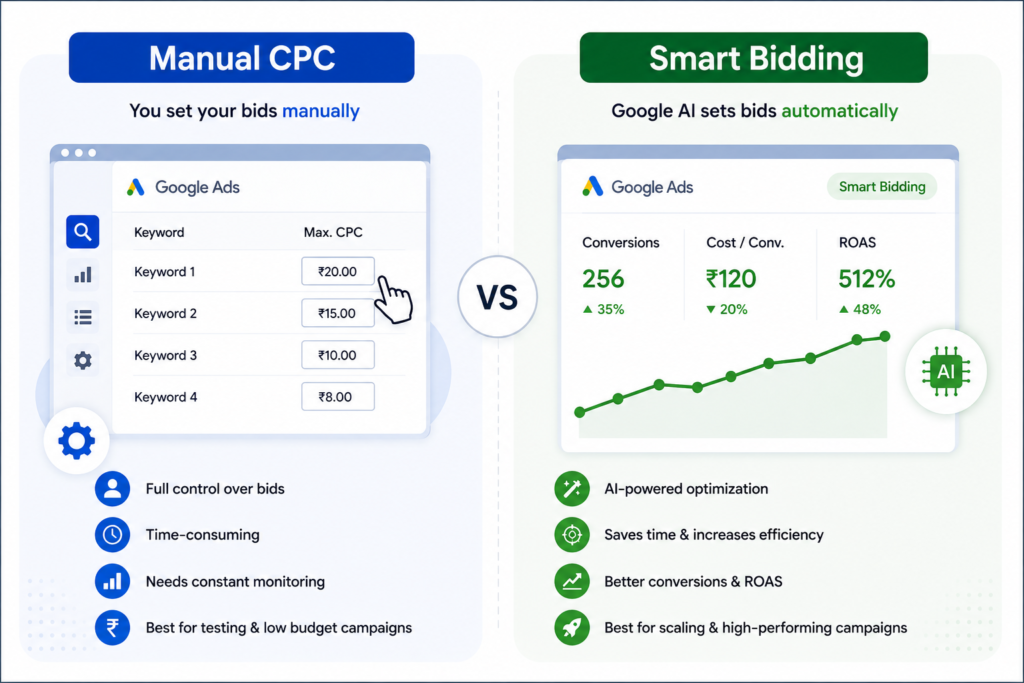
| Feature | Manual CPC | Smart Bidding |
| Automation | Low | High |
| Scalability | Moderate | High |
| Bid Control | Full | Limited |
| AI Optimization | No | Yes |
| Best For | Testing | Conversions |
For most mature campaigns in 2026, Smart Bidding usually delivers stronger long-term performance because it reacts to real-time auction signals faster than manual optimization.
However, Manual CPC can still work effectively for:
-
- Early-stage campaigns
-
- Small accounts
-
- Testing environments
-
- Low-budget advertisers
The best approach depends on campaign goals, data quality, and conversion history.
Best Google Ads Bidding Strategy by Business Type
| Business Type | Recommended Strategy |
| E-commerce Store | Target ROAS |
| Local Business | Maximize Conversions |
| SaaS Company | Target CPA |
| New Website | Maximize Clicks |
| Small Business | Manual CPC |
| Brand Awareness Campaign | Target Impression Share |
Target CPA Bidding Strategy
Target CPA (Cost Per Acquisition) helps advertisers generate conversions at a desired cost per acquisition.
You set your target CPA, and Google automatically adjusts bids to help achieve that goal.
Best For
-
- Lead generation campaigns
-
- Service businesses
-
- SaaS companies
-
- Businesses tracking cost per lead
-
- Mature PPC campaigns
Example
A real estate business switched from Manual CPC to Target CPA and reduced cost per lead by nearly 30% within two months while maintaining lead quality.
Common Mistake
Many advertisers set unrealistically low CPA targets.
This often reduces impressions, limits campaign reach, and decreases conversion opportunities.
A better approach is to gradually lower CPA targets after stable campaign performance develops.
Target ROAS Bidding Strategy
Target ROAS (Return on Ad Spend) focuses on maximizing revenue rather than simply increasing conversions.
For example:
If your target ROAS is 500%, Google aims to generate ₹500 in revenue for every ₹100 spent.
Best For
-
- E-commerce stores
-
- Online retailers
-
- Revenue-focused campaigns
-
- High-ticket products
-
- Shopping campaigns
Important Requirement
Accurate conversion value tracking is essential.
Without proper revenue tracking, Google cannot optimize effectively for ROAS.
Practical Example
An e-commerce fashion brand using Target ROAS may prioritize high-value customers instead of simply generating more traffic.
This often improves profitability over time.
PPC Optimization Tips for Better Conversions
Improve Quality Score
Better Quality Scores can reduce CPC and improve ad positions.
Use High-Intent Keywords
Commercial-intent keywords usually generate stronger conversion rates than broad informational searches.
Optimize Landing Pages
Your landing page should:
-
- Load quickly
-
- Be mobile-friendly
-
- Match ad intent
-
- Include strong CTAs
-
- Provide trust signals
Even the best bidding strategy cannot compensate for a poor landing page experience.
Track Every Conversion
Use tools like:
-
- Google Analytics 4
-
- Google Tag Manager
-
- Enhanced Conversions
-
- Call Tracking
Without accurate conversion tracking, Smart Bidding systems cannot optimize effectively.
Add Negative Keywords
Negative keywords help:
-
- Reduce wasted ad spend
-
- Improve traffic quality
-
- Increase conversion efficiency
Continuously Test Ads
Testing headlines, descriptions, CTAs, and landing pages is still one of the most effective ways to improve PPC performance.
Common Google Ads Bidding Mistakes
1. Switching Strategies Too Frequently
Frequent bidding changes can reset Google’s learning phase and hurt campaign stability.
2. Ignoring Conversion Tracking
Without proper conversion tracking, automated bidding systems struggle to optimize correctly.
3. Using Smart Bidding Too Early
Smart Bidding performs better when campaigns already have a stable conversion history.
4. Weak Landing Pages
A poor landing page experience can destroy conversion rates even if ad targeting is strong.
5. Focusing Only on Clicks
Clicks alone do not guarantee business growth.
Lead quality, sales value, and profitability matter far more than traffic volume.
The Role of AI in Google Ads Bidding
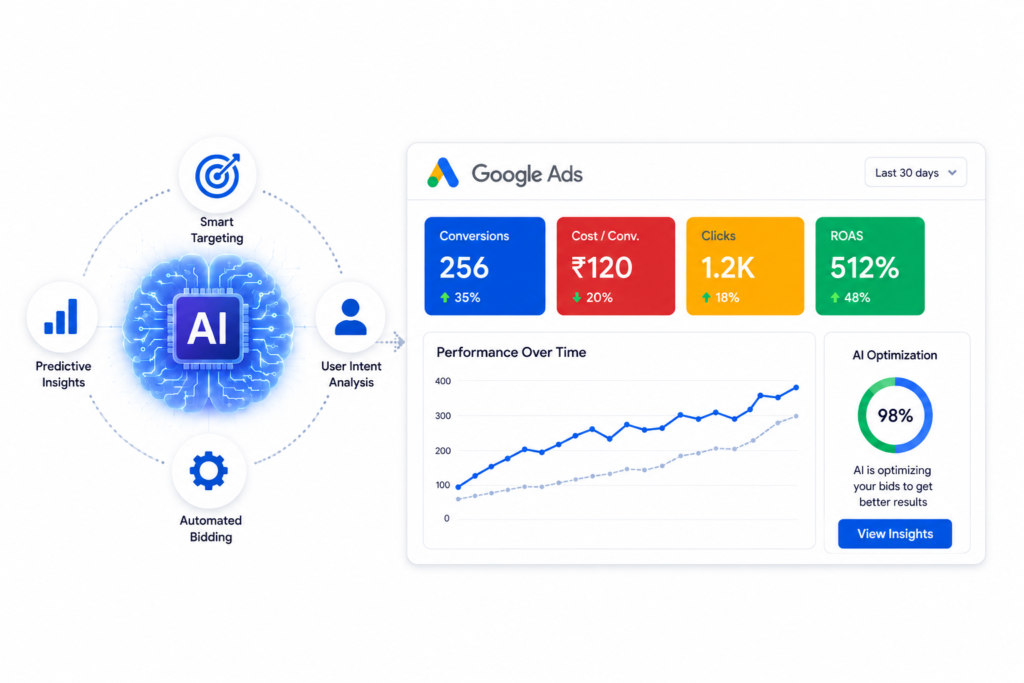
AI is rapidly transforming PPC advertising.
Google now uses:
-
- Predictive bidding
-
- Real-time intent analysis
-
- Audience behavior signals
-
- Machine learning optimization
-
- Conversion probability modeling
Modern AI systems can process enormous amounts of behavioral data faster than human optimization.
For example, Smart Bidding can automatically increase bids for users showing stronger buying intent based on device usage, search patterns, and historical conversion behavior.
In many industries, businesses using AI-powered bidding strategies are outperforming advertisers relying only on manual optimization.
Future of PPC Advertising
The future of PPC will rely heavily on:
-
- Automation
-
- Smart Bidding
-
- First-party data
-
- AI-driven optimization
-
- Privacy-focused targeting
-
- Audience intent signals
-
- Predictive analytics
As Google Ads becomes more automated, advertisers who understand the fundamentals of bidding strategy will gain a major competitive advantage.
Businesses that combine:
-
- Smart Bidding
-
- Strong conversion tracking
-
- Audience targeting
-
- Landing page optimization
-
- Data-driven PPC strategies
will be in a much stronger position to scale profitable campaigns in 2026 and beyond.
Conclusion
Choosing the right Google Ads bidding strategy can significantly improve campaign profitability, lead quality, and overall PPC performance.
Today, successful PPC advertising depends on more than simply increasing bids.
Google now prioritizes:
-
- Audience intent
-
- Conversion probability
-
- Ad relevance
-
- Landing page quality
-
- User behavior
-
- Historical performance data
Businesses that combine Smart Bidding, conversion tracking, optimized landing pages, and audience-focused PPC strategies can improve conversions while reducing wasted ad spend.
There is no single bidding strategy that works for every business.
The best approach depends on:
-
- Campaign goals
-
- Budget
-
- Industry competition
-
- Conversion history
-
- Data quality
-
- Customer intent
In 2026, businesses adapting to AI-driven PPC optimization will be in a much stronger position to scale profitable Google Ads campaigns.