

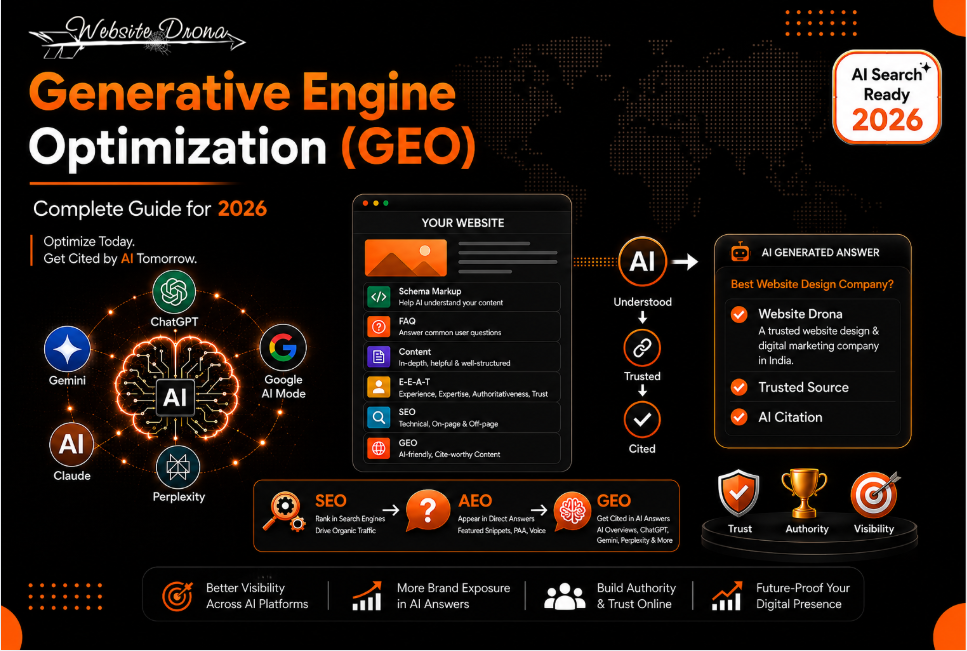
Generative Engine Optimization (GEO) is becoming one of the most important concepts in digital marketing as AI-powered search platforms like ChatGPT, Google AI Mode, Perplexity, Claude, and Gemini continue to change how people discover information online. Instead of showing only a list of search results, these AI systems generate direct answers by selecting and referencing trustworthy sources.
Unlike traditional Search Engine Optimization (SEO), which focuses on improving rankings and driving website clicks, Generative Engine Optimization (GEO) focuses on making your content understandable, trustworthy, and citation-worthy for AI-generated responses. As AI search adoption continues to grow, businesses that optimize their content for GEO have a greater opportunity to increase brand visibility, authority, and discoverability across AI-powered search experiences.
Table of contents:
- Why GEO Matters in 2026
- Understanding Generative Engine Optimization
- Key Features of GEO
- Types of AI Search Optimization (SEO, AEO & GEO)
- How GEO Works: The Query Fan-Out Process
- Workflow: How to Make a Website GEO-Ready
- Role of E-E-A-T in GEO
- Benefits of GEO for Small and Mid-Sized Businesses
- Is GEO Different from Traditional SEO?
- Common Mistakes to Avoid
- Key Takeaways
- Conclusion
- Frequently Asked Questions
Why GEO Matters in 2026
AI-powered search is transforming how people discover information on the internet. Instead of browsing multiple websites, users increasingly rely on AI-powered platforms such as ChatGPT, Google AI Mode, Perplexity, Gemini, and Claude for direct, conversational answers.
This shift means businesses can no longer rely only on traditional SEO rankings. Even if a website ranks well in Google Search, it may miss valuable visibility if AI systems don’t recognize it as a trustworthy source.
Generative Engine Optimization helps businesses adapt to this new search environment by creating content that is well-structured, authoritative, and easy for AI systems to understand and reference. As AI search continues to expand throughout 2026, GEO is becoming an essential part of every modern digital marketing strategy.
Understanding Generative Engine Optimization
For nearly two decades, “getting found online” meant one thing: rank on Google, earn the click, and bring visitors to your website. That single rule shaped how businesses created content, built backlinks, and measured digital marketing success.
That rule is no longer the whole story. Today, millions of people ask ChatGPT, Google AI Mode, Perplexity, Claude, and Gemini questions the same way they once searched Google. Instead of displaying a list of web pages, these AI platforms generate direct answers by analyzing multiple trusted sources and presenting the most relevant information in a conversational format.
This shift has given rise to Generative Engine Optimization (GEO)—the practice of creating and structuring content so AI systems can understand, trust, and reference it in their generated responses. Unlike traditional SEO, which focuses on earning clicks from search results, GEO focuses on increasing the likelihood that your content will be cited or recommended in AI-generated answers.
Key Features of GEO
While GEO shares many principles with traditional SEO, it introduces a different approach to optimizing content for AI-powered search :
- Citation over clicks: The goal is to be referenced inside an AI answer, not necessarily to drive a website visit.
- Depth over density: Content quality, comprehensiveness, and structural clarity matter more than keyword repetition.
- Authority over age: A well-written, expert-backed page from a newer or smaller business can be cited ahead of an older, larger competitor’s thin content.
- Structure-first writing: Content that leads with a direct answer, uses clear headings, and is easy to scan performs significantly better than long, unstructured paragraphs.
- Technical accessibility: If AI crawlers cannot access or render a page, none of the above matters; the content simply won’t be seen.
Types of AI Search Optimization (SEO, AEO & GEO)
Although SEO, AEO, and GEO are closely connected, each serves a different purpose in helping businesses improve their online visibility. Understanding these differences makes it easier to build a search strategy that performs well across both traditional search engines and AI-powered search platforms.
| Term | Full Form | Primary Focus | Typical Outcome |
| SEO | Search Engine Optimization | Improving rankings in traditional search engines like Google and Bing | More organic traffic through search results |
| AEO | Answer Engine Optimization | Optimizing content to appear in featured snippets, People Also Ask, voice search, and AI-generated answer formats | Direct answers and higher visibility in answer engines |
| GEO | Generative Engine Optimization | Structuring content so AI platforms like ChatGPT, Google AI Mode, Gemini, Claude, and Perplexity can understand, trust, and cite it | Brand mentions and citations in AI-generated responses |
SEO, AEO, and GEO are not competing strategies—they complement one another. Strong SEO improves discoverability, AEO increases the chances of appearing in direct answers, and GEO helps your content become a trusted source for AI-generated responses. Businesses that combine all three approaches are better positioned to succeed in both traditional search and the rapidly evolving AI search ecosystem.
How GEO Works: The Query Fan-Out Process
To optimize for GEO, it helps to understand how generative AI search actually behaves, because it works differently from a traditional search engine crawler.
When someone asks an AI tool a broad question, for example, “What’s a good web design company for a small business in Delhi?”, instead of looking for a single matching webpage, the AI analyzes multiple relevant sources to build its response. Instead, it breaks the question into several smaller sub-queries and searches for each one separately. One query might look for “best web design companies Delhi,” another for “affordable website design small business India,” and another for “web design company reviews Delhi NCR.” The final answer draws from whichever sources performed best across all of those smaller searches, not just one.
This is why keyword-stuffing a single phrase no longer works as a strategy. A page needs to comprehensively and clearly answer a topic from multiple angles, in a structure the AI can easily parse, rather than repeating one exact-match keyword as many times as possible. Depth and structure now matter more than sheer keyword density, because AI systems reward content that reads like a genuinely useful answer written by someone who knows the subject.
Workflow: How to Make a Website GEO-Ready
- Check technical access first. Make sure AI crawlers aren’t blocked in the robots.txt file, and confirm that the CDN or security settings, such as Cloudflare, aren’t silently rejecting AI bot requests.
- Avoid hiding content behind JavaScript. Important content should be server-side rendered, not locked behind logins, paywalls, or interactive elements that AI crawlers may not be able to access.
- Use clear heading hierarchies. Structure content with H1, H2, and H3 tags, covering one topic per section, so both human readers and AI systems can quickly understand what each part of the page covers.
- Lead with the direct answer. Start each section with a clear, direct answer to the implied question, and only then follow with supporting context, nuance, and detail.
- Write in scannable formats. Favor bullet points, numbered lists, and short paragraphs over long, unbroken blocks of text.
- Add structured data. Implement schema markup for FAQs, reviews, and product or service information to help AI systems parse the content accurately and confidently.
- Avoid keyword stuffing. Repeating the same keyword unnaturally reduces readability and adds little value. GEO rewards depth and clarity over repetition.
- Consider an llms.txt file, a relatively new addition that helps AI systems understand the overall site structure, in much the same way a traditional sitemap helps conventional search engines.
- Refresh content regularly. Stale, unmaintained pages are less likely to be treated as current, trustworthy sources by AI systems that prioritize up-to-date information.
- Track visibility over time. Periodically ask ChatGPT, Perplexity, or Google AI Mode questions relevant to the business and note whether, and how, it’s mentioned.
Role of E-E-A-T in GEO
Google’s E-E-A-T framework, standing for Experience, Expertise, Authoritativeness, and Trust, has quietly become just as important for AI search visibility as it is for traditional rankings. AI systems increasingly weigh author credentials and real-world credibility when deciding what to cite. Anonymous, generic “content team” articles are treated as weaker signals than content written by identifiable experts with genuine, demonstrable experience in the subject matter.
For a business, this translates into a few concrete habits:
- Attribute content to real people with real expertise, not just a generic byline.
- Back up claims with original data, client case studies, or first-hand results wherever possible.
- Keep information accurate and up to date, since outdated pricing or statistics quietly erode trust with both human readers and AI crawlers.
- Show real credentials, such as a short, honest author bio or notable client work, which does more for AI trust signals than any amount of keyword optimization.
Benefits of GEO for Small and Mid-Sized Businesses
For small and mid-sized businesses, the rise of AI search presents a significant opportunity rather than a challenge. Unlike traditional SEO, where established websites often benefit from strong domain authority and extensive backlink profiles, GEO places greater emphasis on content quality, expertise, clarity, and trustworthiness. This gives businesses with valuable, well-structured content a realistic chance to be recognized and cited by AI-powered search platforms.
Some of the key benefits of GEO include:
1. Compete with Larger Brands
GEO rewards expertise and helpful content over domain size or marketing budget. A well-structured website from a smaller business can be cited ahead of larger competitors if it provides more relevant and trustworthy information.
2. Increased AI Search Visibility
Optimized content is more likely to be referenced by AI platforms such as ChatGPT, Google AI Mode, Gemini, Claude, and Perplexity, helping businesses reach users who rely on AI-generated answers.
3. Stronger Brand Authority
Being mentioned as a trusted source within AI-generated responses reinforces your brand’s credibility and positions your business as an industry expert.
4. Faster Brand Discovery
While traditional SEO often takes months to improve rankings, well-optimized content may begin appearing in AI-generated citations much sooner, depending on the topic and competition.
5. Better Long-Term SEO Performance
The practices that improve GEO—clear structure, original content, strong E-E-A-T signals, and user-focused writing—also contribute to stronger performance in traditional search engines.
6. Improved Content Quality
GEO encourages businesses to create comprehensive, well-organized, and genuinely helpful content instead of relying on keyword stuffing or outdated SEO tactics.
7. Future-Ready Digital Marketing Strategy
As AI-powered search continues to evolve, businesses investing in GEO today are better prepared for the future of online search and changing user behavior.
Is GEO Different from Traditional SEO?
Not exactly. GEO is an extension of traditional SEO, not a replacement. Both focus on creating high-quality, trustworthy, and well-structured content. The main difference is that SEO aims to improve rankings and drive website traffic, while GEO focuses on helping AI platforms understand, trust, and cite your content in generated answers.
Businesses that combine SEO and GEO can improve their visibility across both traditional search engines and AI-powered search platforms.
| Feature | Traditional SEO | GEO (Generative Engine Optimization) |
| Primary Goal | Rank higher in search results and earn clicks | Become a trusted source in AI-generated answers |
| Search Platform | Google, Bing, Yahoo | ChatGPT, Google AI Mode, Gemini, Claude, Perplexity |
| Success Metric | Rankings, organic traffic, CTR | AI citations, brand mentions, AI visibility |
| Content Focus | Keywords, backlinks, technical SEO | Content depth, context, structure, E-E-A-T, citation-worthiness |
| User Journey | Search → Click → Website | Ask AI → Receive Answer → Brand Mention (with or without a click) |
| Primary Optimization | Search engines | AI models and search engines |
| Time Horizon | Ranking improvements often take months | AI citations may appear more quickly depending on content quality |
Businesses that treat GEO as a natural extension of good SEO, rather than a separate, competing discipline, will adapt fastest and see results without having to rebuild their entire content strategy from scratch.
Common Mistakes to Avoid
- Treating GEO as a copy-paste of old SEO tactics. Simply adding more keywords to an existing page rarely helps, since AI systems evaluate comprehensiveness and clarity rather than keyword frequency.
- Ignoring technical accessibility. A well-written page that’s blocked by robots.txt or hidden behind heavy JavaScript rendering may be invisible to AI crawlers regardless of content quality.
- Skipping the FAQ format entirely. Structured question-and-answer content is one of the easiest wins for AEO and GEO visibility, yet many business websites still bury answers inside long paragraphs.
- Chasing high-volume keywords instead of buyer-intent questions. A smaller, more specific question with genuine commercial intent is often more valuable to be cited for than a broad, high-traffic term with little connection to an actual purchase decision.
- Publishing AI-generated content without human review, original insights, or real-world expertise makes it less likely to be trusted or cited by AI systems.
Key Takeaways
- GEO focuses on AI visibility rather than only search rankings.
- High-quality, well-structured content is more likely to be cited by AI systems.
- Strong E-E-A-T signals improve trust and authority.
- GEO complements traditional SEO instead of replacing it.
- Technical accessibility and structured data remain essential.
- Businesses that adapt early can gain a competitive advantage in AI search.
Conclusion
Artificial intelligence is transforming how people search for information, making Generative Engine Optimization (GEO) an essential extension of modern SEO. Businesses that create original, well-structured, and trustworthy content are more likely to be recognized and cited by AI-powered search platforms such as ChatGPT, Google AI Mode, Perplexity, Claude, and Gemini.
Rather than replacing SEO, GEO strengthens your overall digital visibility by helping your content perform across both traditional search engines and AI-generated search experiences. As AI search continues to evolve, investing in GEO today can help build long-term authority, improve brand recognition, and prepare your website for the future of online search.
Want Your Business to Be Recommended by ChatGPT & Google AI?
Getting ranked on Google is no longer enough. Your business also needs to be visible in AI-generated answers.
Website Drona specializes in AI SEO, GEO, AEO, Technical SEO, and Website Development to help businesses increase online visibility across both traditional search engines and AI-powered platforms.
Talk to our experts today and receive a personalized AI Search Optimization roadmap for your business.
Frequently Asked Questions
1. What is the GEO full form in digital marketing?
GEO stands for Generative Engine Optimization. It is the practice of creating and structuring content so AI-powered search platforms like ChatGPT, Google AI Mode, Gemini, Claude, and Perplexity can understand, trust, and reference it in their generated answers.
2. How is GEO different from traditional SEO?
Traditional SEO focuses on improving rankings in search engine results to drive website traffic, while GEO focuses on making content easy for AI systems to understand and cite in AI-generated responses. GEO complements SEO rather than replacing it.
3. Why is GEO important in 2026?
As more users rely on AI-powered search tools for answers, businesses need to optimize their content for AI visibility. GEO helps improve the chances of being cited by AI platforms, increasing brand awareness and authority.
4. Can small businesses benefit from GEO?
Yes. GEO rewards high-quality, well-structured, and trustworthy content rather than domain size or marketing budget. This allows small and mid-sized businesses to compete with larger brands in AI search.
5. How long does it take to see results from GEO?
There is no fixed timeline. Some businesses may start appearing in AI-generated citations within a few weeks, while consistent visibility typically develops over several months as content quality and authority improve.