

Building a lead-generating website in 2026 is no longer just about design—it’s about combining smart strategy with AI-driven experiences. In today’s AI era, users expect personalized content, fast performance, and seamless interactions. From optimized landing pages and compelling CTAs to AI-powered chatbots and data-driven insights, every element plays a role in turning visitors into potential customers. This guide will walk you through the essential steps to create a website that not only attracts traffic but consistently converts it into high-quality leads.
What Is a Lead-Generating Website?
A lead-generating website is a conversion-focused digital platform designed to turn website visitors into qualified leads, inquiries, or paying customers. Unlike a traditional brochure website that only presents information, a lead-generating website functions as a structured sales system — combining strategy, content, design, and user experience to consistently drive business results.
Key functions of a lead-generating website:
- Communicates a clear, specific value proposition within the first 5 seconds
- Addresses visitor intent and pain points directly
- Builds trust through social proof and credibility signals
- Guides users toward a defined conversion action (inquiry, booking, or purchase)
Why Most Business Websites Fail to Generate Leads
Most websites underperform not because of poor design, but because of missing strategy. Industry data shows that the average website converts only 2–3% of visitors — meaning 97 out of every 100 visitors leave without taking action.
Here are the five most common reasons a website fails to generate leads:
1. No defined conversion goal Without a single, primary objective, visitors have no clear path forward. Every page should answer: What do I want the visitor to do next?
2. Weak or unclear value proposition If a visitor cannot understand what you do and why it matters to them within 5 seconds of landing, they will leave. Clarity always outperforms cleverness.
3. Design that ignores conversion principles A visually attractive website is not the same as a high-performing one. Layout, hierarchy, and flow matter more than aesthetics alone.
4. Missing conversion elements No contact forms, no clear CTAs, no lead magnets — no leads. Every page needs at least one action point.
5. Absence of trust signals Without testimonials, case studies, certifications, or real results, visitors have no reason to take the next step. Trust is a prerequisite to conversion.
How to Build a Lead-Generating Website: A Step-by-Step Framework
Step 1 — Define Your Primary Conversion Goal
Before designing a single page, answer this question: What is the one action I most want visitors to take?
Common conversion goals include:
- Submitting an inquiry form
- Booking a discovery call or consultation
- Downloading a lead magnet (guide, checklist, or report)
- Requesting a quote or proposal
Every design, content, and UX decision should serve this goal.
Step 2 — Research and Understand Your Target Audience
A lead-generating website is built around user intent, not business preferences. To understand your audience, identify:
- Who they are: Industry, role, company size, or demographics
- What problems they face: The specific pain points your solution addresses
- What outcome they want: The transformation or result they are seeking
- What objections they have: Concerns that prevent them from taking action
This research directly shapes your messaging, content, and offers.
Step 3 — Apply a Conversion-Focused Website Design
Design should guide visitors toward action — not distract them. At Websitedron.com, every website we build follows these core design principles:
- Clean, uncluttered layouts that reduce cognitive load
- Clear visual hierarchy that directs the eye toward CTAs
- Mobile-first responsiveness (over 60% of web traffic is mobile)
- Fast page load speed (each additional second of load time reduces conversions by up to 7%)
- Consistent brand identity that builds recognition and trust
Step 4 — Write Clear, Outcome-Focused Content
Content is the engine of lead generation. Effective website copy does three things simultaneously: it solves a problem, explains a benefit, and motivates action.
Content principles that improve conversion:
- Lead with the outcome the visitor wants, not your company background
- Use plain language — avoid jargon unless your audience demands it
- Structure content for scanners: use short paragraphs, subheadings, and bullet points
- Include proof points within body copy (statistics, results, timeframes)
Step 5 — Place Strong, Action-Oriented CTAs
Your call-to-action (CTA) is the bridge between interest and conversion. Weak or vague CTAs kill lead generation.
Characteristics of high-converting CTAs:
- Specific and benefit-driven: “Get My Free Website Audit” beats “Submit”
- Urgency when appropriate: “Book Your Spot — Limited Availability”
- Strategically placed: Above the fold, after key value sections, and at the bottom of every page
High-converting CTA examples for service businesses:
- “Request a Free Consultation”
- “Get Your Custom Quote”
- “Book a 30-Minute Strategy Call”
- “See How We’ve Helped [Industry] Businesses”
Step 6 — Optimize Your Lead Capture System
Even motivated visitors will abandon a lead form if it creates friction. Optimize your capture system by:
- Limiting form fields to 3–4 maximum (name, email, phone, and one qualifying question)
- Using conversational form labels that feel natural, not bureaucratic
- Offering multiple contact options (form, phone, WhatsApp, or live chat)
- Confirming submissions immediately with a thank-you page that sets expectations
Website Conversion Rate Benchmarks:
| Performance Level | Conversion Rate |
| Below average | Under 2% |
| Industry average | 2–3% |
| High-performing | 5%+ |
| Top-tier (optimized) | 8–10%+ |
If your website converts below 2%, structural and strategic changes are needed — not just design tweaks.
Step 7 — Build SEO Into the Architecture
Search engine optimization ensures the right people find your website. SEO for lead generation goes beyond keywords — it’s about intent alignment.
Core SEO practices for lead-generating websites:
- Target intent-driven keywords: Focus on what your potential customers search when ready to hire (e.g., “web design agency for small business” not just “web design”)
- Structure pages with clear heading hierarchy: H1 → H2 → H3 following logical content flow
- Optimize page titles and meta descriptions with specific, action-oriented language
- Build internal links between service pages, blog posts, and landing pages
- Publish high-quality content that answers questions your audience is actively searching
Step 8 — Optimize for AI Search and Answer Engines (AEO + GEO)
In 2025, a growing percentage of searches will be answered directly by AI tools — including Google’s AI Overviews, ChatGPT, Perplexity, and other generative search platforms. This shift makes Answer Engine Optimization (AEO) and Generative Engine Optimization (GEO) critical for website visibility.
How to optimize your website for AI-generated answers:
- Write in a question-and-answer format: Structure content so that AI tools can extract clear, attributable answers
- Use specific, factual, and cited information: AI tools prefer authoritative content backed by data
- Add structured FAQ sections to every key page — these are prime candidates for AI extraction
- Use schema markup (FAQ, HowTo, Article) to help search engines and AI tools classify your content
- Write direct definitions at the top of key sections — AI models often lift the first clean, clear sentence as their answer
- Maintain topical authority: Publish interconnected content clusters around your core service areas, not isolated blog posts
Websitedron.com Insight: Websites optimized for AI answer engines are being cited and referenced by tools like ChatGPT and Perplexity, creating a new channel for lead generation beyond traditional search. Building for AEO today means positioning your business ahead of the AI-driven search shift.
Step 9 — Establish Trust and Credibility
Trust is not optional — it is the prerequisite for conversion. A visitor who doesn’t trust you will not become a lead, regardless of how good your offer is.
Trust-building elements every lead-generating website needs:
- Client testimonials with full names, company names, and ideally photos
- Case studies showing the problem, the process, and the measurable result
- Portfolio or work samples relevant to the visitor’s industry or need
- Recognizable client logos (with permission)
- Certifications, awards, or media mentions
- Team page with real photos and bios — people buy from people
Step 10 — Structure Your Website as a Conversion Funnel
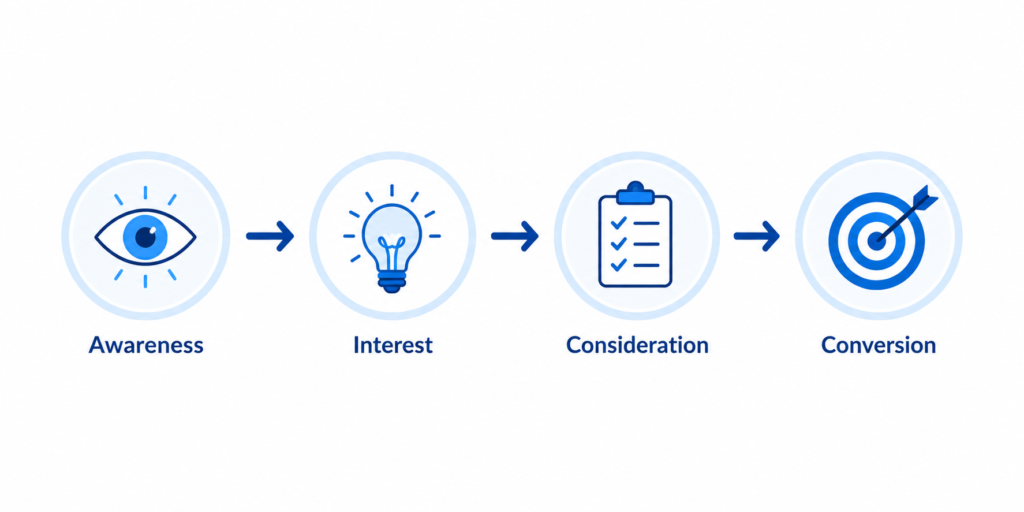
A high-performing website is not a collection of pages — it is a structured journey. Every page should move the visitor one step closer to converting.
The lead-generation funnel structure:
- Awareness: “This website understands my problem” (clear headline, relevant imagery)
- Interest: “This solution sounds relevant to me” (benefits-focused content)
- Consideration: “They’ve done this before and succeeded” (social proof, portfolio)
- Intent: “I want to learn more or get started” (strong CTA, easy contact)
- Conversion: “I’ll reach out now” (low-friction form or booking system)
Common Mistakes That Kill Website Lead Generation
Avoid these high-impact errors:
- Overloaded homepages trying to say everything to everyone — dilutes your message and confuses visitors
- Generic, company-first copy that leads with “We are a leading provider of…” instead of addressing the visitor’s needs
- CTAs buried at the bottom of long pages with no repeat placement above the fold
- No mobile optimization — if your site is hard to navigate on a phone, you’re losing the majority of visitors
- Slow load speed — Google’s Core Web Vitals directly affect both ranking and bounce rate
- No analytics or tracking — without data, optimization is impossible
Advanced Lead Generation Strategies for Growing Businesses
Once your core website is optimized, these strategies accelerate lead generation:
Dedicated landing pages Create specific pages for each service, campaign, or audience segment. A landing page with a single CTA consistently outperforms a generic homepage for conversion.
Retargeting campaigns Re-engage visitors who left without converting using display or social retargeting ads. These visitors already know your brand — the cost-per-lead is significantly lower.
Email follow-up sequences Capture leads with a lead magnet (checklist, audit, or guide), then nurture them with automated email sequences that build trust over time.
Content marketing for compounding SEO and AEO Consistently publishing well-structured, authoritative blog content builds topical authority — which improves both Google rankings and AI answer engine citations simultaneously.
Conclusion
In 2025, a website that only represents your business is not enough. A lead-generating website actively works as your best-performing salesperson — available 24/7, consistently communicating your value, building trust with every visitor, and converting traffic into real business inquiries.
The difference between a website that sits idle and one that generates consistent leads is not budget — it is strategy, structure, and optimization.
At Websitedron.com, we specialize in building websites designed specifically to generate leads for businesses. From conversion-focused design to AEO-Optimized content, every decision is made with one goal: turning your website into a growth engine for your business.
Ready to turn your website into a lead-generating machine? Request a Free Website Consultation →
Frequently Asked Questions
Q1. What makes a website generate leads?
A lead-generating website combines a clear value proposition, conversion-focused design, strategic CTAs, trust signals, and a low-friction contact system. Traffic alone does not generate leads — structure and intent alignment do.
Q2. Why is my website getting traffic but no leads?
If you have traffic but no leads, the most common causes are: unclear messaging that doesn’t match visitor intent, weak or missing calls-to-action, lack of trust signals, or a contact process with too much friction. A website audit can identify the specific conversion gaps.
Q3. How long does it take for a website to generate leads?
With the right structure in place, initial improvements in inquiry rates can appear within 2–4 weeks. However, consistent, scalable lead generation through SEO typically takes 3–6 months of sustained effort.
Q4. Is SEO still important for lead generation in the AI era?
Yes — and it’s more important than ever. SEO now encompasses traditional search rankings and AI answer engine visibility (AEO/GEO). Websites with strong SEO foundations are more likely to be cited by AI tools like ChatGPT, Google AI Overviews, and Perplexity.
Q5. What is the average conversion rate for a business website?
The industry average is 2–3%. A well-optimized, conversion-focused website can achieve 5–10%+. If your site converts below 2%, it needs strategic and structural changes.